
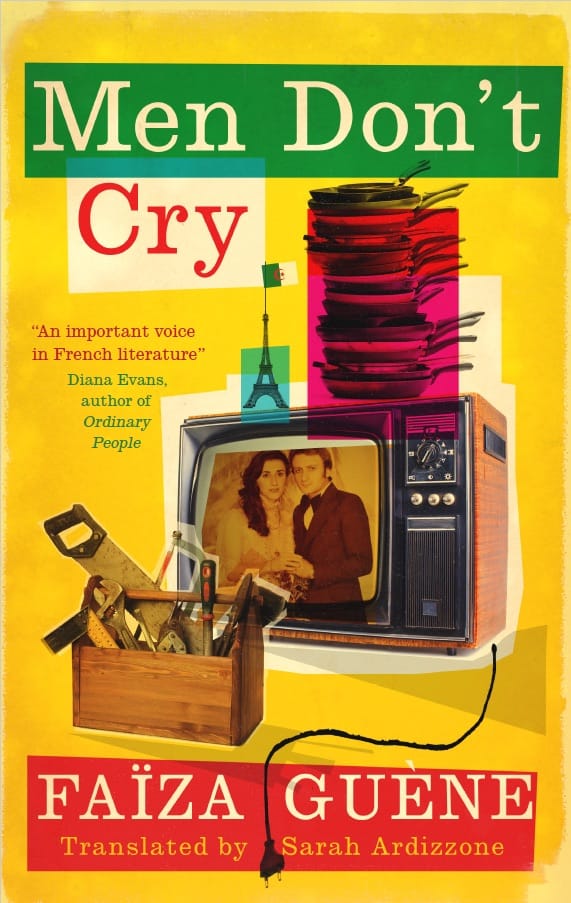
Men Don’t Cry
Price range: ₦11,000.00 through ₦13,000.00
His sister chose freedom. His family called it betrayal. Now Mourad must decide whether love can survive both.
Born to Algerian parents in Nice, Mourad Chennoun has spent years avoiding conflict and the forbidden name of his estranged sister, Dounia.
But when his father suffers a stroke, Mourad leaves home for the Paris suburbs and attempts to bridge the painful divide tearing his family apart.
Men Don’t Cry by Faïza Guène is a witty and deeply moving novel about masculinity, migration, feminism, family loyalty and the struggle to belong between two cultures.
Perfect for readers who enjoy humorous, character driven fiction that asks whether becoming free must mean leaving your family behind.
Men Don’t Cry: A Powerful Story of Family and Identity
His sister chose freedom. His family called it betrayal. Now Mourad must decide whether love can survive both.
Men Don’t Cry invites readers into the home of Mourad Chennoun, a young French man born to Algerian parents in Nice.
His father spends his days repairing discarded objects in the backyard.
His mother mourns the Algerian village she left behind and holds tightly to the traditions that still connect her to home.
Inside the Chennoun household, one name has become forbidden.
Dounia, Mourad’s older sister, left the family years earlier in search of freedom.
When Mourad’s father suffers a stroke, the family’s carefully maintained silence can no longer protect them from the past.
A Family Divided by Freedom
Dounia has always wanted a life different from the one her parents planned for her.
As a child, she compares her strict Algerian household with the freedoms enjoyed by her French friends.
She begins to see family traditions as restrictions rather than sources of identity and belonging.
On 11 September 2001, Dounia leaves and promises never to return.
Her departure devastates her mother and creates a wound the family refuses to discuss openly.
Years later, Mourad finds himself caught between loyalty to his parents and his desire to understand his sister.
Men Don’t Cry asks whether freedom must always require rejection and whether family love can survive years of anger and silence.
Mourad Leaves Nice for Paris
Mourad fears becoming an unmarried man permanently tied to home by duty, anxiety and his mother’s cooking.
His father’s illness forces him to confront responsibilities he has spent years avoiding.
He leaves Nice and begins a teaching career in the Paris suburbs.
The move gives him physical distance from his family and introduces him to a faster, less predictable life.
Paris brings new friendships, relationships and challenges.
Mourad encounters people navigating immigration, class, romance and the instability of undocumented life.
He also discovers that Dounia has reinvented herself as a fierce feminist, aspiring politician and committed assimilationist.
In Men Don’t Cry, the search for his sister gradually becomes Mourad’s search for his own identity.
Living Between Algeria and France
The Chennoun family belongs to two countries without feeling completely secure in either one.
Mourad and his siblings were raised in France, but Algeria remains present inside their home.
It survives through food, language, memories, family expectations and their mother’s longing for her village.
Outside the home, they are expected to behave as fully French citizens.
Yet French society continues reminding them of their Algerian origins.
This creates a painful contradiction.
Assimilation appears to demand that they surrender parts of their history without guaranteeing that society will accept them.
Men Don’t Cry explores the emotional strain of being asked to choose between identities that have always existed together.
Tradition, Modernity and Family Loyalty
Every member of the Chennoun family responds differently to migration and cultural change.
Their mother protects tradition because it connects her to the home she lost.
Their father’s habits reflect memories of scarcity, labour and survival.
Dounia believes freedom requires rejecting the expectations placed on her as an Algerian daughter.
Mourad tries to avoid choosing a side.
His younger sister, Mina, must also negotiate the competing demands of family and French society.
No character is presented as completely right or completely wrong.
Men Don’t Cry allows readers to understand how love, fear and history can make the same family experience freedom in opposing ways.
Feminism and the Price of Independence
Dounia’s feminism gives her a language through which to challenge the restrictions she experienced at home.
It also shapes her public identity and political ambitions.
From her perspective, family loyalty can become a demand that women accept control and sacrifice.
Her mother sees the situation differently.
She experiences Dounia’s rejection as an abandonment of family, culture and everything she endured for her children.
Mourad stands between these two positions.
He must learn to recognise the sexism his sister resisted without dismissing his mother’s pain.
Men Don’t Cry explores feminism as both a path towards freedom and a source of conflict within a traditional immigrant family.
Masculinity and Emotional Silence
The title raises an important question about the emotional expectations placed on men.
Mourad has learned to hide fear, uncertainty and vulnerability behind humour and avoidance.
His father also expresses love through actions rather than emotional conversations.
Neither man finds it easy to say what he feels.
This silence does not eliminate pain.
It allows grief, anxiety and resentment to remain unresolved.
Mourad’s journey requires more than finding his sister.
In Men Don’t Cry, he must learn that emotional honesty is not a betrayal of masculinity.
A Funny and Affectionate Family Novel
Despite its serious themes, the novel is filled with humour.
Mourad observes his family, colleagues and Parisian life with sharp comic intelligence.
His narration finds absurdity in politics, romance, education and contemporary French culture.
The humour gives the characters warmth and prevents them from becoming representatives of social issues rather than believable people.
Faïza Guène writes about the Chennoun family with affection, even when exposing their contradictions.
Readers may disagree with individual characters while still understanding the experiences that shaped them.
This combination makes Men Don’t Cry both entertaining and emotionally insightful.
Why You Should Read Men Don’t Cry
- It offers a witty portrait of an Algerian immigrant family in France.
- It explores masculinity, feminism and emotional vulnerability.
- It examines the pressures faced by second generation immigrants.
- It moves between Nice and the multicultural suburbs of Paris.
- It presents complex family conflict without simple villains.
- It considers whether assimilation can ever guarantee acceptance.
- It combines humour with thoughtful social commentary.
- It explores family estrangement and the possibility of reconciliation.
- It is written by the acclaimed author of Kiffe Kiffe Tomorrow.
- It is translated into English by Sarah Ardizzone.
Who Should Read This Novel?
Men Don’t Cry will appeal to readers of contemporary French literature, immigrant family stories and coming of age fiction.
It is ideal for readers interested in cultural identity, migration, feminism and the North African diaspora.
Readers who appreciate humorous, character driven novels about complicated families will enjoy Mourad’s distinctive voice.
The novel is also an excellent choice for book clubs discussing assimilation, gender roles, sibling relationships and belonging.
It can support university courses in French literature, migration studies, gender studies, translation and diaspora writing.
Discover more compelling fiction in Cassava Republic Press’s African and Black women’s stories collection.
You can also explore other translated books through Cassava Republic Press’s complete book collection.
About Faïza Guène
Faïza Guène is an acclaimed French writer and filmmaker of Algerian heritage.
She achieved international recognition with her debut novel Kiffe Kiffe Tomorrow, published when she was 19.
Her fiction examines family, migration, class, race and the experiences of multicultural France.
Guène is known for creating distinctive characters whose humour reveals the contradictions of everyday life.
Men Don’t Cry was translated into English by award winning translator Sarah Ardizzone.
Order Men Don’t Cry Today
Men Don’t Cry is a funny, affectionate and deeply observant novel about a family divided by different definitions of freedom.
It asks whether honouring your origins must prevent change and whether embracing a new identity requires rejecting the people who raised you.
Most importantly, it shows that reconciliation begins when people find the courage to speak about what hurts.
Order your copy today and join Mourad on his unforgettable journey through family, masculinity, migration and belonging.
| Weight | 0.5 kg |
|---|---|
| Dimensions | 60.0 × 0.4 × 6.0 cm |
| ISBN-10 | 9781911115694 |
| Book Author | |
| Book Type | Paperback |
| year_publication | 2022 |
| Pages | 216 |
Be the first to review “Men Don’t Cry”
Read alongside Men Don't Cry


Reviews
There are no reviews yet.