
What happens when books become dangerous?
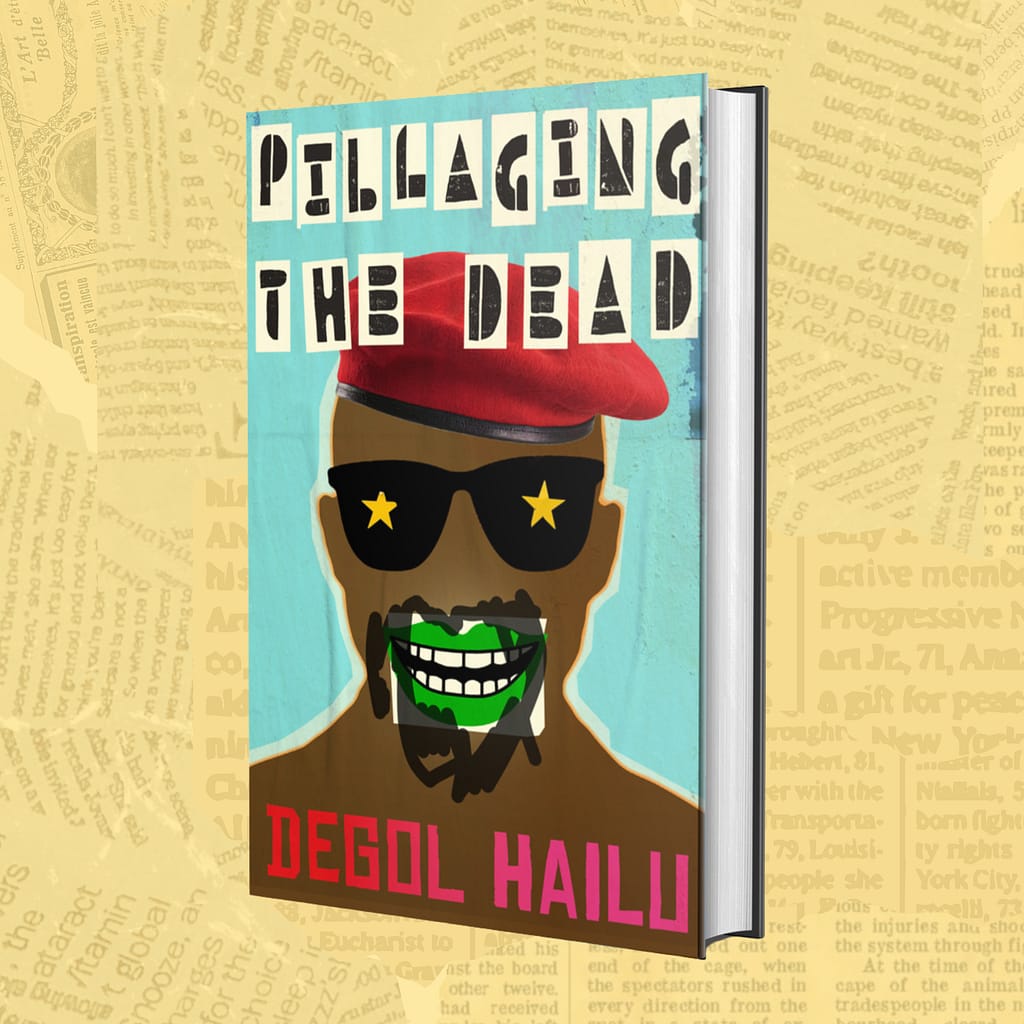
In Pillaging the Dead, Degol Hailu takes us into a world where books are banned, political cartoons are dangerous, and a young bookseller finds himself caught up in a struggle far bigger than he expected. Darkly comic, sharp and deeply concerned with the relationship between power and ideas, the novel asks what happens when the things we read, write and say become threats to those in power.
Ahead of the publication of Pillaging the Dead on 5 November, we spoke to Degol Hailu about writing his debut novel.
Tell us, in your own words, about Pillaging the Dead.
Pillaging the Dead is born out of a long-standing frustration. Let me explain.
I used to buy books from street booksellers while living in the country where the novel’s idea was first conceived. They would approach potential buyers at traffic lights, outside shops or at petrol stations.
For a few months, they disappeared from the streets. When I saw them again, they looked as if they had been through a difficult period. One of them had bruises and marks of desperation on his face. He told me they had been arrested and beaten for selling banned books—those written by authors the government didn’t like or considered dangerous.
I went home that day and couldn’t stop thinking about the arrest of those booksellers. Together with my own experience of living under repressive regimes and of interacting with some in my professional life, the seeds of Pillaging the Dead were planted that very night.
The book has become a tribute to the victims of political repression, including those booksellers and the many dissidents who are imprisoned, tortured, and banished in many countries. You could also say the story is driven by my personal vendetta against the regimes responsible for such atrocities.
Could you explain the title to us?
The title is inspired by a real-life incident. A government, in a country I used to live in, decided to demolish a cemetery where my family members were buried. We had to move their bodies because the government had a plan to build a road that cuts through the cemetery. The task of moving the bodies was complicated, mainly because local gangs also had a habit of stealing the metal coffins and the marble headstones.
A couple of years later, the city authorities turned up again. This time, they wanted to widen the road and brought in the bulldozers. They moved the bodies themselves and buried them in a mass grave. At that point, it felt as if they were ‘pillaging the dead’.
Hence, the title has a biographical element, as do many of the incidents in the book.
Whilst the novel belongs to Tarik, Pillaging the Dead is told from multiple points of view, including the antagonists. Why did you want to tell the story this way?
I wanted to write the novel without imposing my own assumptions and perspectives on the characters, especially the antagonists. I wanted to explore their life experiences by stepping outside my biases. I wanted to examine what shaped their behaviour. Essentially, without claiming to be a psychoanalyst, it is my attempt to suggest that the antagonists’ actions could perhaps be explained by their past lives, beyond their government or party affiliations.
You previously worked at the UN as a senior advisor. What did the role involve, and to what extent did your work inform the novel? You’ve lived around the world, under various different systems of government. How much did these experiences inform Pillaging the Dead?
At the UN, my work involved supporting countries in formulating economic policies and implementing reforms. It also involved meeting government officials and attending many meetings with them. These interactions have definitely influenced the novel.
One example perhaps demonstrates it very well. I once attended a meeting where the country’s president was giving a speech. I noticed the chair he was sitting on was a special kind, much more decorative and comfortable than the one the rest of us sat in. I learned that the president travelled with that chair wherever he went. In fact, within his motorcade, there was a dedicated vehicle and driver that carried the chair. Such incidents inspired the novel’s satirical moments.
Pillaging the Dead is a fascinating and insightful account of the challenges, and sometimes indignities and absurdities of living under a dictatorship. Why is this something you wanted to write about, and why did you choose fiction as the medium for this?
One of the reasons I wanted to write about living under totalitarian regimes is that I also lived under three political systems: an absolute monarchy, a military dictatorship, and one-party rule. My family and I were affected by these successive authoritarian systems, from imprisonment to execution.
The medium for telling these stories could have been a memoir or a work of non-fiction. But a memoir would have limited the story to a few characters connected to me. Besides, I do not think my life is that interesting to fill a memoir (smile). Non-fiction would also have made it read like a report by a human rights organisation. Fiction opens opportunities to explore many characters and their backstories and to add satirical elements.
Pillaging the Dead draws attention to the community organising [political activism] element of protest and resistance. Is this something you wanted to explore?
Yes. Pillaging the Dead shows that absolute power impacts many sections of society. Not only booksellers but also painters and actors are harassed. Those who live in informal settlements are constantly evicted. Street children and the homeless are seen as blemishes on city life. Academics are under constant surveillance.
Therefore, in Pillaging the Dead, I wanted to reiterate that the fight for freedom is more likely to succeed if activists from all walks of life come together. This is best achieved through political activism and organisation. That is why Tarik and his friends engaged in activism during their university days and later joined a political party to challenge the regime.
I hope the above answer does not sound as if I am saying the book is a political manifesto. It is not. It is simply a work of fiction inspired by many real events I have researched, as well as the kinds of biographical stories I mentioned above.
Which authors and books have inspired you?
Chinua Achebe and his incisive and humorous critique of people in power.
George Orwell and his dystopian worlds, explained in simple and direct prose.
What are you writing about next?
I am currently working on two ideas.
The second is a novella. It’s also a political satire that explores the fast-growing global podcasting industry. The characters in the story represent the extremists on both sides of the political, economic and cultural debates. The podcasters and their guests are portrayed with humour and hyperbole to expose the dangers of fascism and totalitarianism creeping into our midst.
The first is a novel set in the mid-20th century in an African country where people were bought and sold into servitude until the practice was abolished in 1942. This is the true-story part. The novel follows a 17-year-old girl who has been in bondage under this system since the age of one. She later joins a school opened for freed people and begins a new life. She embarks on a mission to discover how she came to be the property of one man, only to discover that her past involved no selling or buying, but rather a life owed to a simple act of kindness from the very same man who owned her.
Pillaging the Dead comes out 5th November 2026. Pre-order now!
