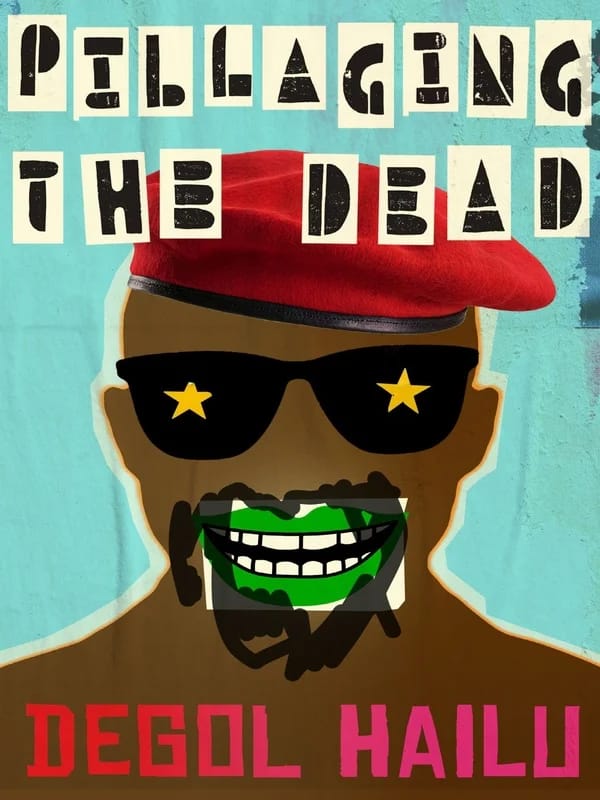
Pillaging the Dead
£16.99
Tarik sells banned books to survive. One violent police raid turns him into the enemy the state is determined to silence.
In an unnamed African country ruled by fear, university student Tarik earns money selling forbidden books, pirated music and his own political cartoons.
When he falls into the hands of the feared Central Investigation Bureau, he is pulled into a dangerous network of activists, dissidents, underground printers and revolutionary artists.
Pillaging the Dead by Degol Hailu is a darkly comic African political satire about censorship, dictatorship and the price of refusing to remain silent.
Sharp, unsettling and irresistibly propulsive, this debut novel is perfect for readers of political thrillers, contemporary African fiction and stories of resistance.
Pillaging the Dead by Degol Hailu
In a country where a cartoon can be treated as treason, silence may be the only safe choice.
Tarik is a university student trying to survive in a city controlled by an authoritarian regime.
Between his studies, he works as a street hawker. He sells banned books, pirated music and political cartoons to commuters trapped in the city’s endless traffic.
The work is risky, but it gives Tarik a way to earn a living. It also allows forbidden ideas to pass from one person to another.
Everything changes when a police raid turns violent.
Beaten and taken into the custody of the feared Central Investigation Bureau, Tarik is forced to confront the real danger of challenging the state.
Pillaging the Dead is Degol Hailu’s darkly comic and deeply unsettling debut novel about censorship, political resistance and the absurdities of life under dictatorship.
A Dangerous World of Banned Books and Secret Police
Tarik’s arrest draws him into a hidden world of underground printers, dissidents, activists and revolutionary artists.
These are people who understand that a poem, book or cartoon can become dangerous when those in power fear independent thought.
Some resist publicly. Others distribute forbidden material in secret or use humour to expose the regime’s hypocrisy.
Every act carries a cost.
As surveillance closes around him, Tarik must decide what he is prepared to risk. Remaining silent might protect him, but silence also allows injustice to continue.
Through Tarik’s journey, Pillaging the Dead asks what happens when ordinary people are pushed into extraordinary political choices.
Pillaging the Dead Is a Dark African Political Satire
Although the novel confronts imprisonment, corruption and state violence, it also possesses a sharp comic energy.
The regime’s officials speak with confidence even when their decisions make no sense. Bureaucratic rules become instruments of intimidation, while political slogans attempt to disguise fear and failure.
Humour becomes a way of exposing these contradictions.
Rather than making oppression seem less serious, the satire reveals how authoritarian power depends upon performance, repetition and collective pretence.
The result is an African political satire novel that can be funny in one moment and frightening in the next.
When Satire Becomes a Threat to the State
Tarik’s political cartoons transform familiar frustrations into images people can immediately understand.
That makes them powerful. It also makes them dangerous to officials who want complete control over how the country is described.
In Pillaging the Dead, art is never separate from politics. Books, music and cartoons circulate ideas that cannot be contained by official speeches or government propaganda.
The novel shows why authoritarian governments fear laughter. A joke can strip power of its appearance of strength and expose the insecurity beneath it.
This theme makes the book especially compelling for readers interested in freedom of expression, censorship and the relationship between creativity and political resistance.
A Political Thriller Driven by Resistance
The novel combines political satire with the momentum of a thriller.
Tarik encounters corrupt officials, secret police, underground campaigners and citizens doing whatever they can to survive.
Trust becomes difficult. A stranger might offer help, report him to the authorities or be pursuing a dangerous plan of their own.
Each decision takes Tarik deeper into a struggle whose consequences extend beyond his personal safety.
This propulsive structure makes Pillaging the Dead ideal for readers who want serious political fiction without sacrificing suspense, danger or momentum.
An Unnamed Country with Recognisable Problems
Degol Hailu sets the novel in an unnamed African country.
This allows the story to speak beyond one particular nation. Its corrupt bureaucracy, state surveillance and political inequality will feel recognisable to readers in many parts of the world.
The setting also prevents readers from treating authoritarianism as someone else’s problem.
Governments may use different slogans, uniforms and institutions, but the methods used to control information and discourage dissent can be remarkably similar.
Pillaging the Dead examines these systems through the experience of a young person who did not begin as a revolutionary. Tarik is first a student and street hawker trying to make his way through everyday life.
His transformation gives the novel its emotional force.
Why You Should Read Pillaging the Dead
- A compelling protagonist caught between personal safety and political responsibility
- A striking combination of political thriller and dark satire
- A powerful exploration of banned books and freedom of expression
- An unsettling portrait of surveillance and authoritarian government
- Revolutionary artists, underground printers and political activists
- Sharp observations about corruption, propaganda and inequality
- A fast moving story with humour, danger and emotional depth
- An exciting debut from Ethiopian writer Degol Hailu
Who Will Enjoy This Novel?
This novel will appeal to readers of contemporary African fiction, political thrillers and literary satire.
It is also an excellent choice for readers interested in books about censorship, dictatorship, student activism and freedom of expression.
Readers who appreciate morally complicated characters will be drawn to Tarik’s journey. His choices are shaped by danger, uncertainty and the knowledge that resistance can harm the people he hopes to protect.
Fans of political fiction that combines urgent social questions with suspense and humour will find much to admire in Pillaging the Dead.
Discover More African Political Fiction
Readers interested in another gripping story about artists confronting political power can explore The Aquatics by Osvalde Lewat.
For a powerful novel about imprisonment, journalism and life under military rule, discover Waiting for an Angel by Helon Habila.
Readers who enjoy fearless Nigerian political satire may also appreciate Be(com)ing Nigerian: A Guide by Elnathan John.
To learn more about international work defending writers and freedom of expression, visit PEN International.
About Degol Hailu
Degol Hailu was born in Ethiopia and later moved to the United Kingdom.
He earned a PhD in economics from SOAS, University of London, where he also worked as a research fellow.
Hailu subsequently joined the United Nations and worked in cities including New York, Brasilia, Port of Spain, Brussels and Addis Ababa.
He has published widely on economic development and now lives and writes in London.
Pillaging the Dead is his debut novel.
Preorder Pillaging the Dead Today
Pillaging the Dead is a gripping story about what happens when fear can no longer keep people silent.
Darkly funny, politically urgent and filled with danger, it reveals how books, cartoons and courageous individuals can threaten even the most repressive state.
Preorder your copy today and enter a world where forbidden ideas travel faster than fear.
| Weight | 0.5 kg |
|---|---|
| ISBN | 978-1-913175-78-8 |
| Author | Degol Hailu |
| Format | Hardback |
| Publication Date | 5th November 2026 |
Reviews
There are no reviews yet.