
Behind the Story – Elemental Blackness by Cherise Morris
Oct
Behind the Story is a series that invites our authors to share the inspiration behind their books and the stories behind their creation.
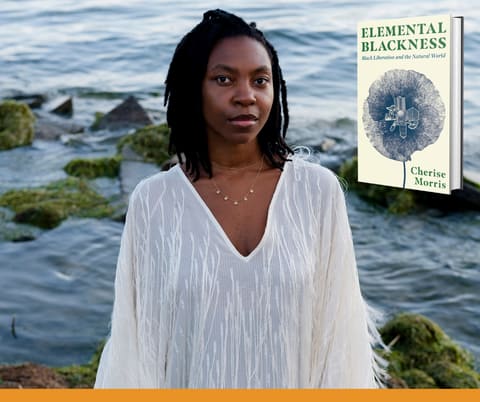
In this instalment, Cherise Morris reflects on the ideas and experiences that inspired Elemental Blackness, her exploration of Blackness, ancestry and the natural world.
Eight years ago, I wrote four poems after walking the length of New Orleans — one for each of the four natural elements. Those poems would go on to become the backbone of a book I’m immensely proud of. I come from a lineage of writers whose work was never read. And I can’t take credit for all of these words because there were moments that I can only describe as events of automatic writing — an ancestor whose name I’ll never know whispering into my ear and guiding my fingertips.
There is a silence in this work. It’s strange, beautiful and complicated. It’s a mouthful of a title. And more than that, it acknowledges things the Western framework rejects as illegitimate — and places them on the pedestal of knowledge — the ancient gods of Africa, the presence of the ancestors walking beside us, the fact that the natural world is alive, sentient, and conscious, not a passive bystander to be extracted from and toyed with by humans who lack the respect to care for it. It centralizes the fact that we are not above nature, and the ways we mistreat this planet are powerful reflections of the fallacies we regard ourselves by and the mistreatment we allow of others and ourselves. In this work, Afro-indigenous and diasporic frameworks are not written off as strange mythologies or anthropological curiosities. They are positioned as legitimate sources of knowledge and sophisticated philosophies, lineages of resistance, and part of the roadmap to collective liberation and a free future.
At its core, it’s a book about the ways the violence and oppression of black communities and the destruction and degradation of the natural world have always been inextricably connected. At its soul, it’s a book about redefining new philosophies that emerge from ancestral ways of understanding to reconceptualize identity in relationship to the natural world, and our collective liberation as intimately connected to the healing of the natural world we emerge from.
We’ve spent decades and generations contemplating systems — what’s wrong with them and how to change them — but in those tireless cyclical conversations, we so often overlook that in order to change any system we must first change as the people animating it. And in order to change ourselves as people, we have to fundamentally change how we understand every part of who we are, how we relate to one another and how we relate to the planet we depend on. I come from people of the land, of the water, of the wind — people rich in knowledge who defined themselves first and foremost by their relationship with the divine natural world that made them possible, not within the constructions and constraints of people who saw themselves as less than a human whole. This work is a hymnal to blackness, the backwoods of my origin and the post-industrial blues of the place where I actualized my truest sense of self. This is an homage to the wisdom that raised me, to Esmont, Virginia, to Detroit — the Blackest city in America, to the ancestors who were great thinkers and philosophers, who lived freedoms I could only imagine, to the ancestors who learned this new land and built bonds with it so I could be here today. This is my offering to all those ‘country’ black folks I came from, to the dirt and water and the air that made my existence possible, and a testament not only to the lessons of my origins but to my deep and unwavering faith that this world does not have to remain in the shambles we know of it today. A system that exploits and destroys the planet we all depend on for life will absolutely exploit and destroy people. A system that exploits and destroys people will absolutely exploit and destroy the planet we all depend on for life. And to create a different system — one that doesn’t sustain itself by exploiting and destroying people and the natural resources all people need to live — we have to reach back into the past, and reclaim diasporic and indigenous ideological frameworks that affirm and protect the sanctity of human life and the planet we live on. This is my philosophy. I’m grateful to the ancestors, the spirits, the energies and deities for trusting me with it.
