
Q&A with Osvalde Lewat
Jun
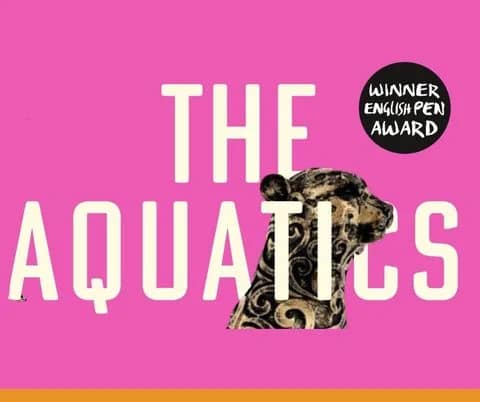
Cameroonian writer, filmmaker, and photographer Osvalde Lewat makes her fiction debut with The Aquatics, a novel that explores friendship, loyalty, identity, and the quiet violences embedded within social norms.
In this conversation, she reflects on the friendship that inspired The Aquatics, the influence of documentary filmmaking on her writing process, the creation of Zambuena, and the authors who have shaped her literary imagination. She also shares insights into her creative rituals, the challenges of writing a first novel, and the conversations she hopes the book will spark among readers.
In your own words, how would you describe The Aquatics to a reader?
The Aquatics is the story of a woman, a teacher, the wife of a powerful man, and mother of two, whose over strict conventional life comes undone the day her closest friend that she loves like her brother, is arrested and jailed because he is gay. His downfall forces her to confront the life choices she has, once accepted without questioning and a life shaped by social expectation and duty rather than desire.
What was the idea that sparked your novel?
As a teenager, I read Narcissus and Goldmund by Hermann Hesse, and instinctively knew that one day I would tell a story about deep friendship colliding with the harsh complexity of reality. Over the years, the novel gradually took shape in my mind through my own encounters with life. When I first discovered Hesse’s novel, I too was living an extraordinary friendship with my late best friend, who was gay. It was a friendship built on solid ground and an unspoken understanding of one another. Our friendship ended only when he flew to the sky. In many ways, his story could have become the story of one of the characters in The Aquatics. Losing him made me understand that time is not expandable. I felt an urgency to finally write that fiction I had been carrying since my adolescence. The characters of The Aquatics, who had long existed somewhere at the edge of my imagination, suddenly became impossible to ignore.
The Aquatics centres the friendship between Katmé and Samy within a society that criminalises Samy’s identity. What inspired you to explore this relationship, and why did you choose friendship as the lens for telling a queer story?
I became aware very early in life of the stigmatisation and violence directed at homosexuals in Cameroon first and later around the world. I have witnessed people around me rejected by their families and communities after their sexuality became known. Long before state legal homophobic repression against homosexuality, there is often another form of violence, that is exclusion by those closest to you. In societies where the community still exerts strong control over the individual, being cast out by one’s group amount to a social death.
I wanted to explore how such violence reverberates not only through the lives of those directly targeted, but also through the emotional lives of those who love them. Friendship became essential to the novel for that reason.
In many narratives, romantic love structures the story through recognisable stages: encounter, conflict, resolution. Friendship resists that kind of expected narrative. It allows for a more unstable and ambiguous emotional territory, shaped by forms of attachment that do not necessarily seek definition. For me, friendship offered a way of displacing the emotional center of the novel. Between Katmé and Samy, the say friendship becomes a space where intimacy exists outside possession, outside social roles, and outside the language usually available to describe human bonds. Their relationship reveals something fundamentally unclassifiable in human connection, a fragile form of truthfulness that persists despite fear and political violence.
What did the writing process, from the idea to finishing your novel, look like?
To write my novel, I needed first to know the story from beginning to end, even though many things changed during the writing process. I began by writing an extended synopsis of sligthly ten pages. From there, I constructed the ecosystem of the characters and mapped the network of relationships, tensions, and interactions that connected them. I worked on all of this in separate documents.
It was a long and painstaking prepping phase. I needed to know the characters from their inside out, meaning their motivations, emotional lives, desires, and private quests. This comes from my background in documentary filmmaking, where preparation and structure beforehand are indispensable. Yet despite all this scaffold, once I began writing, the characters often escaped the architecture where I wanted to confine them. I wrote a first draft in six months and discarded the entirely 300 hundreds pages. It ultimately took me three years to finish The Aquatics.
Which authors would you say impacted your work the most?
José Saramago, Toni Morrison, Doris Lessing, Ahmadou Kourouma and Albert Camus have shaped my relationship to literature, each in very different ways. These writers though very different share a common belief in literature as a space for a radical exploration of human beings and societies. What I find powerful in their works is their portraying of identity as a shifting and fragmented reality, which is constantly shaped by doubt, crisis, and metamorphosis. They are writers who confront directly what disturbs us most.
Could you reveal a fun fact about your creative process? This could be where you like to write, a unique writing ritual you have to unlock creativity, or how you go about writing.
Before starting writing, I always light candles on the altar where I keep photographs of my mother and my loved ones who have passed away. Their faces watch over the room, and they accompany the work. The altar is in my bedroom where I work. Since I write in my bed, my laptop on my knees.
What books would you recommend to someone looking to explore Cameroonian literature?
Behold the Dreamers, by Imbolo Mbue
Your Name Shall Be Tanga, by Calixthe Beyala
The Poor Christ of Bomba, by Mongo Beti
The Old Man and the Medal, by Ferdinand Oyono
It Shall Be of Jasper and Coral, by Werewere Liking
The Aquatics is your debut novel. What was the most rewarding and the most challenging part of writing a first novel?
The most rewarding part was meeting my characters every morning, living alongside them day after day, sometimes hearing them argue, guided me, or leaded me astray. I had the feeling that they were real, I had somehow brought them to life, and that was frightening and exhilarating at the same time. It is when I started having breakfast with them, meaning talking to myself and to my imaginary companions, that my family became concerned. However, I guess the more difficult part was the gap between the ideas I had in my head and what I was able to actually put down on the page.
How did your experiences living in different countries influence the political and social environment you created in Zambuena?
I was born and raised in Cameroon, and certain realities specific to that country naturally run through the novel. But living also in several other African countries allowed me to witness differences, nuances, and, above all, the many resonances that exist between these societies. I wanted to place those singularities and similarities into dialogue within a new and reinvented territory. Certain aspects of Zambuena’s political structure, for example, were inspired by the Democratic Republic of the Congo where, after the assassination of Laurent Désiré Kabila, the country was governed by one President and four Vice Presidents. My novel is therefore threaded with constitutional, political, and social references drawn from the different countries where I have lived.
Colonisation often produced arbitrary borders, grouping populations that were sometimes different within the same territory. By inventing an African country of my own, I wanted to reenact that gesture of territorial construction, but from an African imagination, that is, at once extending it, diverting it, and subverting it. I was also interested in playing with the persistent fantasy of Africa as a single, undifferentiated country. Because the book was first published in French, some Western readers told me, quite seriously, that they knew Zambuena or hoped to visit it one day. I found that amusing, but it also reinforced my belief that fiction can sometimes become more powerful than reality. After all, many African states themselves began as imagined constructions before becoming political realities onto which people projected themselves.
As a multidisciplinary creative filmmaker and photographer, how have your visual storytelling experiences influenced your fiction writing?
I think in images, like a sort of collage. Before I write, I see colours, characters’ scenes unfolding in my mind. I have never felt that this detail hinders reading. On the contrary, I like the reader to enter a world with as much precision as possible, to know immediately, through vivid and concrete details, where they are. I make documentary films, not fiction. My background in documentary filmmaking undoubtedly shapes this relationship to detail and observation. Documentary is, in many ways, more constraining than literature. It corsets you, binds you to accuracy and fidelity to reality. You cannot invent the subject or alter the words of the people whose lives you are filming. You are assigned to precision, to what exists, whereas literature, on the other hand, allows you to invent different and multiple worlds and perspectives to move beyond the limits shaped by the visible. Literature frees my imagination.
Cinema is visual by definition. Unless one makes a film with a black screen and a voice-over, images are given directly to the viewer. The mental reconstruction of the story is secondary since the narrative is carried by visible bodies that do not invite imagination in the same way, because the narrative is already embodied before them. When I read Song of Solomon, for example, I can imagine the characters’ appearances fifteen different times. Someone else will imagine them entirely differently and insist that my vision is wrong. That is precisely what is beautiful about literature. Every reader constructs a personal universe within the text and the novel ends up as a shared space of imagination between writer and reader. That freedom rarely exists in cinema in the same manner.
What conversations do you hope your book sparks amongst readers?
I hope this novel encourages readers to reflect on the violence that can hide behind societies “normalities” — which are sometimes the projection of the quiet mechanisms of exclusion and conformity that shape people’s lives long before any official punishment takes place. I also hope it opens conversations about friendship, loyalty, and the ways political systems enter the most intimate parts of our bodies and lives.
What is the one thing you’d like a reader to take away from reading your book?
We all carry contradictions along with zones of opacity that resist easy definition. I would like readers to come away with the feeling that human beings can never be reduced to a single identity, a single voice, a unique social role, or a label imposed upon them by others. If there is one thing, I hope my novel leaves behind, it is the awareness that a life can change suddenly when the structures we rely on begin to crack open.
Purchase The Aquatics
About the Author
Osvalde Lewat is a Cameroonian-born photographer, director, and writer. She began to share her visual and narrative universe through documentary films. Author of several award-winning works that deal with socio-political subjects and that bring out reflections on alterity, she graduated from Sciences-Po Paris and has completed image training courses at Femis in Paris, and at the Institut National de l’Image et du Son (INIS) in Montreal. Her films, broadcast by more than seventy television channels around the world, have traveled to the five continents and received several international awards, including the Tanit d’Or at Carthage, the Étalon de Bronze at Fespaco and the prestigious Peabody award at the United States. Her photos have been exhibited in Africa, Europe and America. THE AQUATICS, her first novel won Pan-African Prize for Literature, the French Academy literature and the Kourouma Prize. The book has been translated in seven languages including Japanese and Swahili. Alongside her artistic activity, Osvalde Lewat, who has lived in different countries around the world (France, Canada, Comoros, Congo-Kinshasa, Burkina Faso, etc.), is involved in several associative projects of a socio-cultural nature in africa.
