
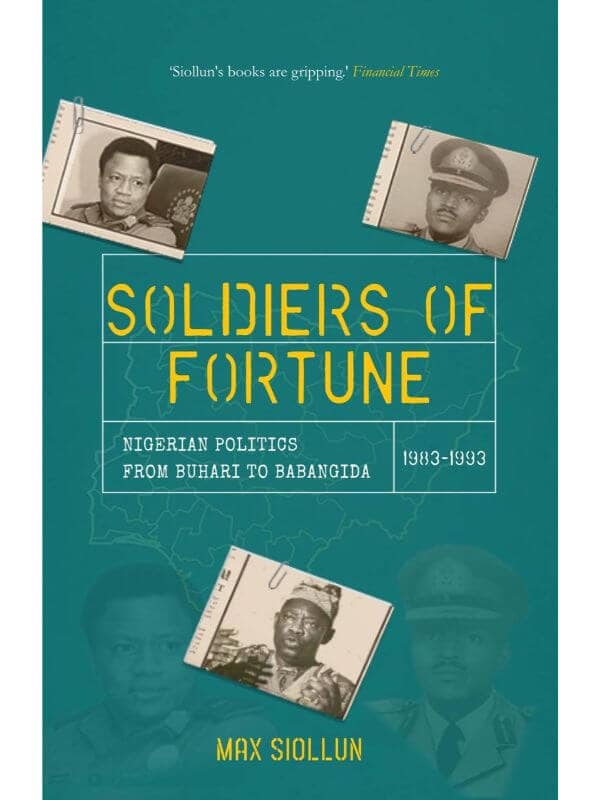
Soldiers Of Fortune
Coups, assassinations, secret plots and one annulled election: discover the decade that changed Nigeria forever.
Soldiers of Fortune by Max Siollun takes readers inside the military governments of Muhammadu Buhari and Ibrahim Babangida.
From the attempted kidnapping of Umaru Dikko to the assassination of Dele Giwa and the annulment of the June 12 election, Siollun uncovers the people and decisions behind Nigeria’s most controversial political events.
Fast paced, revealing and remarkably accessible, this is essential reading for anyone who wants to understand how military rule shaped modern Nigeria.
Soldiers of Fortune by Max Siollun
How did ten years of military rule transform Nigeria’s politics, economy and national identity?
Soldiers of Fortune by Max Siollun takes readers inside one of the most dramatic periods in Nigerian history.
Between 1983 and 1993, Nigeria experienced military coups, political executions, economic crisis and an increasingly complicated transition towards democracy.
Generals Muhammadu Buhari and Ibrahim Babangida dominated this era.
Their governments introduced policies and political practices that continue to influence Nigeria today.
Max Siollun explains these developments through detailed research and a gripping narrative that makes complex history easy to follow.
Ten Years That Changed Nigeria
The story begins with the military coup of December 1983.
The coup removed President Shehu Shagari and brought Major General Muhammadu Buhari to power.
Buhari’s government promised discipline, accountability and an end to the corruption associated with the civilian administration.
Its policies soon generated controversy.
The government restricted political activity, detained public figures and introduced severe measures intended to change public behaviour.
Less than two years later, Buhari was removed by another military coup.
Major General Ibrahim Babangida emerged as Nigeria’s new leader in August 1985.
His government promised a more open style of leadership and a transition to civilian rule.
However, that transition would become one of the longest and most complicated political programmes in Nigeria’s history.
Buhari, Babangida and Military Power
Soldiers of Fortune examines the different personalities and governing styles of Buhari and Babangida.
Buhari presented himself as a strict and disciplined military leader.
Babangida cultivated the image of a smiling, politically skilled president who could negotiate with competing groups.
Behind these contrasting images were military officers, politicians, advisers and business leaders competing for influence.
The book examines how personal relationships affected government decisions.
It also reveals the alliances and rivalries that shaped life within the armed forces.
Readers are taken beyond official announcements and public ceremonies.
They encounter the calculations, disagreements and ambitions operating behind military power.
The Attempted Kidnapping of Umaru Dikko
One of the most extraordinary incidents covered in the book is the attempted kidnapping of Umaru Dikko.
Dikko had served as a senior minister during Nigeria’s Second Republic.
After the 1983 coup, Buhari’s government accused him of corruption and sought his return from Britain.
In 1984, Dikko was kidnapped in London and placed inside a crate intended for transportation to Nigeria.
British officials discovered the plot before the crate could leave the country.
The failed operation caused a serious diplomatic crisis between Nigeria and Britain.
Max Siollun examines the planning, participants and political consequences of this remarkable episode.
The Mamman Vatsa Coup Trial
The book also investigates the alleged coup plot associated with Major General Mamman Vatsa.
Vatsa was a senior military officer, writer and childhood friend of Ibrahim Babangida.
He and several other officers were accused of plotting to overthrow the government.
Following a military trial, Vatsa and other convicted officers were executed in 1986.
The case remains one of the most controversial events of the Babangida era.
Soldiers of Fortune examines the evidence, personal relationships and questions surrounding the alleged conspiracy.
The Assassination of Dele Giwa
In October 1986, journalist Dele Giwa was killed by a parcel bomb delivered to his Lagos home.
Giwa was a respected journalist and one of the founders of Newswatch magazine.
His killing shocked Nigeria and became a lasting symbol of the dangers faced by journalists.
The murder has generated accusations, denials and competing theories for decades.
Max Siollun reconstructs the political atmosphere surrounding Giwa’s death without turning speculation into established fact.
The result helps readers understand why the assassination remains one of Nigeria’s most troubling unresolved cases.
The Gideon Orkar Coup
On 22 April 1990, Major Gideon Orkar and other officers attempted to overthrow Babangida’s government.
The coup announcement proposed the removal of several northern states from the Nigerian federation.
Fighting broke out in Lagos, and Babangida narrowly escaped the attack.
The government eventually defeated the coup plotters.
The incident exposed serious tensions involving military loyalty, ethnicity, religion and national unity.
The book reconstructs the planning and failure of the coup while explaining its wider political significance.
Economic Crisis and Structural Adjustment
Military rule affected more than Nigeria’s political institutions.
The Babangida government introduced the Structural Adjustment Programme in response to economic crisis and declining oil revenue.
The programme changed the value of the naira and reduced government involvement in parts of the economy.
Many Nigerians experienced rising prices, unemployment and falling living standards.
Public opposition led to protests, strikes and increasing distrust of the government.
Soldiers of Fortune connects these economic decisions to the political unrest of the period.
It explains how economic hardship changed public attitudes towards military rule.
The June 12 Election Annulment
The climax of the book is the presidential election held on 12 June 1993.
Businessman Moshood Kashimawo Olawale Abiola contested against Bashir Tofa.
The election was widely regarded as peaceful and credible.
Preliminary results indicated that Abiola was heading towards victory across religious and regional divisions.
Before the results were fully announced, Babangida’s government annulled the election.
The decision triggered protests, political instability and a national crisis.
The annulment destroyed public confidence in the military government’s transition programme.
It also transformed June 12 into one of the most important dates in Nigeria’s democratic history.
Max Siollun examines the key personalities, competing interests and decisions that led to the annulment.
History Written Like a Political Thriller
This is a carefully researched history book, but it does not read like a dry academic textbook.
Max Siollun presents events through clear explanations, dramatic scenes and memorable personalities.
Military officers, politicians, journalists and activists emerge as complicated individuals rather than distant historical names.
The narrative moves quickly while still providing the political context readers need.
This approach makes Soldiers of Fortune suitable for both general readers and students of African history.
Why You Should Read Soldiers of Fortune
- It explains Nigerian politics under Buhari and Babangida.
- It investigates the military coups of the 1980s and early 1990s.
- It explores the attempted kidnapping of Umaru Dikko.
- It examines the Mamman Vatsa coup trial and executions.
- It reconstructs the Gideon Orkar coup attempt.
- It provides context for the assassination of Dele Giwa.
- It explains the economic consequences of structural adjustment.
- It investigates the annulment of the June 12 election.
- It connects military rule to present day Nigerian politics.
- It makes complex political history accessible and compelling.
Who Should Read This Book?
This book is essential for readers interested in Nigerian political history, military government and the development of democracy.
It will benefit students of history, political science, international relations, journalism and African studies.
Journalists, policymakers and researchers will find a clear account of the people and decisions that shaped this period.
Younger Nigerians can also use the book to understand events that continue to influence national political conversations.
Explore More Nigerian History
To understand the earlier forces that created modern Nigeria, read Formation: The Making of Nigeria from Jihad to Amalgamation by Fola Fagbule and Feyi Fawehinmi.
Readers interested in the personal consequences of military dictatorship can also explore A Small Silence by Jumoke Verissimo.
For an independent assessment of the book’s historical significance, read The Guardian’s review of Soldiers of Fortune.
About Max Siollun
Max Siollun is a Nigerian historian and writer specialising in Nigerian military and political history.
His work is known for combining extensive research with clear and engaging storytelling.
His other books examine Nigeria’s military coup culture, colonial history and later periods of military and civilian government.
Understand the Decade That Reshaped Nigeria
Soldiers of Fortune reveals how military ambition, political rivalry and economic crisis brought Nigeria to a defining national moment.
It shows that the controversies of this era are not merely events from the past.
Their consequences remain visible in Nigerian politics, institutions and public life.
Order Soldiers of Fortune today and discover the history behind the Nigeria we know now.
| Weight | 0.5 kg |
|---|---|
| Dimensions | 60.0 × 0.4 × 6.0 cm |
| Book Author | |
| Print ISBN | 978-9785023824 |
| Publication Date | 2013 |
| Pages | 384 |
| Book Type |
Reviews
There are no reviews yet.