
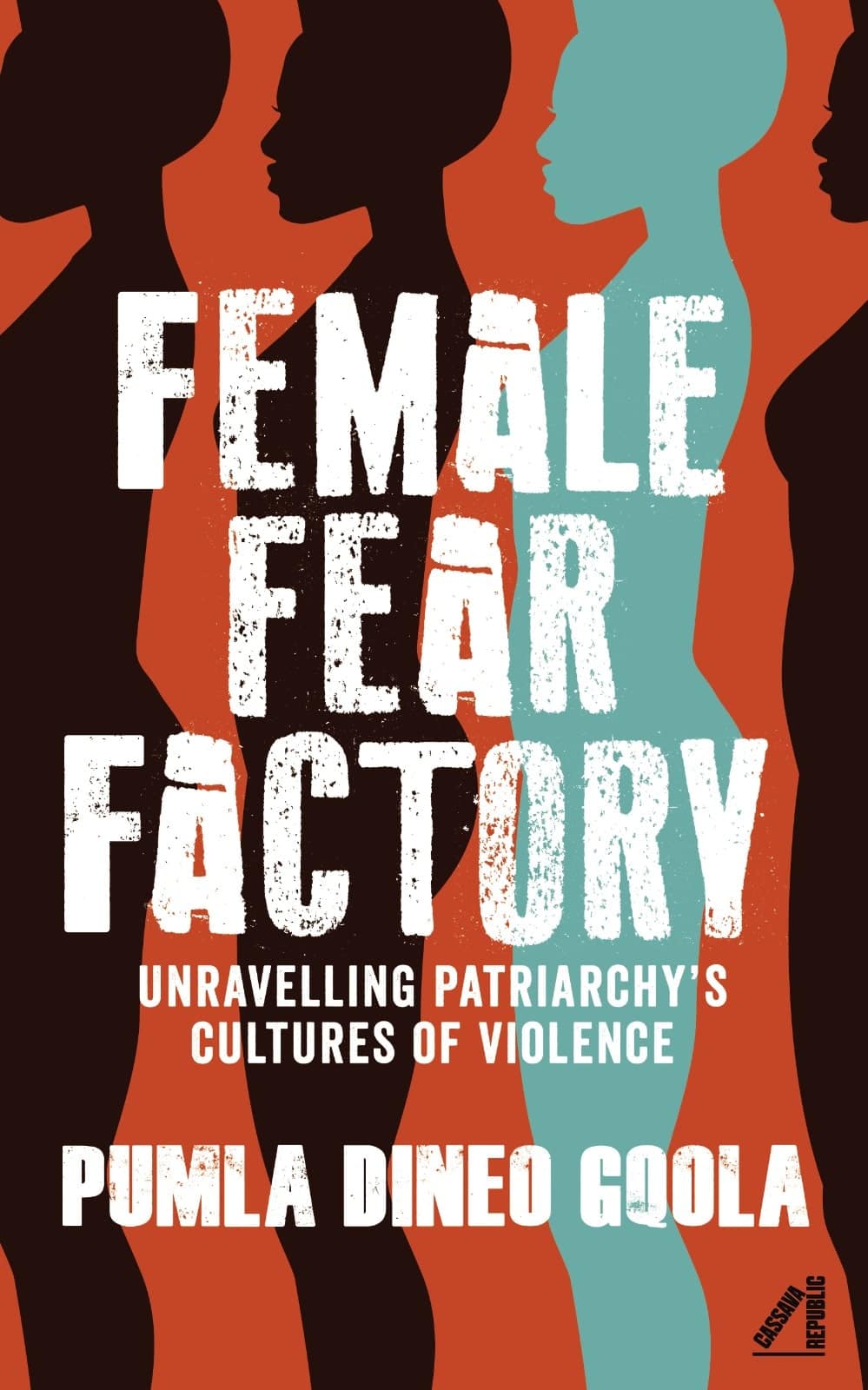
Female Fear Factory
₦11,000.00 – ₦13,000.00Price range: ₦11,000.00 through ₦13,000.00
What if women’s fear is not accidental, but deliberately produced to keep them obedient?
In Female Fear Factory, acclaimed feminist thinker Pumla Dineo Gqola exposes how patriarchy turns streets, homes, schools and workplaces into spaces of fear. Drawing on examples from Africa and across the world, this award winning book reveals the machinery behind violence against women while offering a courageous vision of feminist resistance, freedom and collective change.
An essential read for anyone ready to understand how fear controls women and how that control can be challenged.
Female Fear Factory: A Powerful Examination of Patriarchy and Violence
An empty street at night. A crowded bus. A university lecture hall. A workplace controlled by a coercive superior. These may appear to be unrelated spaces, but each can become a place where women are taught to anticipate danger and organise their lives around fear.
What if that fear is not simply a natural response to danger? What if it is deliberately produced, repeated and sustained because it helps patriarchy maintain control?
Female Fear Factory by Pumla Dineo Gqola provides a compelling framework for understanding how fear is used to discipline women and people who are constructed as female. It reveals that women’s fear is not merely personal. It is political, social and deeply connected to structures of power.
How Fear Becomes a Tool of Control
Women are often taught from childhood to be constantly alert. They are warned about what to wear, where to go, how to speak and when to return home. When violence occurs, society frequently questions the woman’s choices instead of focusing on the person or system responsible for the harm.
Gqola describes this process as a factory because it repeatedly manufactures fear. Families, governments, educational institutions, religious structures, media narratives and cultural expectations can all contribute to its production.
Female Fear Factory shows how that fear limits movement, ambition, expression and freedom. It can influence whether a woman accepts a job, attends an event, challenges authority, leaves an abusive relationship or speaks openly about an experience of violence.
The author also demonstrates that these restrictions do not operate independently. Street harassment, driving bans, coercive professors, intimate violence and political oppression can all function as parts of the same patriarchal machinery.
A Global Study Grounded in African Feminist Thought
Drawing on examples from Uganda, Nigeria, South Africa, Saudi Arabia, Europe and the Americas, Gqola demonstrates that patriarchy is not confined to one country, religion or culture.
Its methods may change from place to place, but its dependence on fear remains remarkably consistent. Nationalism, racism, capitalism, xenophobia and social inequality can strengthen the systems that place women and marginalised people at risk.
This global approach makes the book valuable to readers searching for African feminist books, gender studies texts or accessible nonfiction about patriarchy. Gqola’s analysis is grounded in Black and African feminist thought while remaining relevant to readers across the world.
Rather than treating African women only as victims, the book recognises their intellectual traditions, political resistance and ability to imagine new forms of freedom.
Connecting Public Violence and Private Fear
One of the book’s most important arguments is that violence in public and violence in private are connected. The fear a woman experiences on an unfamiliar street cannot be completely separated from the fear created inside a home, relationship, classroom or workplace.
Female Fear Factory examines how intimacy can be manipulated under patriarchal conditions. Romantic relationships are often presented as safe spaces, yet they can also become locations of control, coercion and femicidal violence.
The book challenges readers to examine the stories societies tell about love, masculinity and respectable womanhood. It asks why women are expected to manage men’s behaviour, prevent their own victimisation and remain silent to protect families or institutions.
These questions make it an important contribution to conversations about violence against women, rape culture, intimate abuse and the social construction of female vulnerability.
Beyond Fear Towards Feminist Resistance
Although the book offers a sobering account of patriarchal violence, it does not end in hopelessness. Gqola turns towards feminist imagination as a means of challenging the systems that depend on female fear.
She encourages readers to recognise fear as something produced rather than something women naturally carry. If fear is manufactured, its machinery can be identified, interrupted and dismantled.
Resistance may involve refusing silence, supporting survivors, creating safer communities, challenging harmful institutions and imagining relationships that are not built around domination. It can also mean defending the freedom of women to occupy public spaces without being blamed for the violence directed towards them.
Female Fear Factory therefore does more than explain a problem. It provides language through which readers can recognise patterns that are often normalised or treated as isolated incidents.
Why You Should Read Female Fear Factory
- It explains how fear is produced and used to control women.
- It connects street harassment, intimate violence and institutional coercion.
- It examines patriarchy across Africa, Europe, the Americas and the Middle East.
- It offers an important African feminist perspective on global violence.
- It challenges myths that blame women for the violence committed against them.
- It combines rigorous social analysis with clear and compelling writing.
- It offers a hopeful vision of resistance, solidarity and feminist imagination.
This is essential reading for students and teachers of gender studies, sociology, African studies, politics and cultural studies. It will also appeal to activists, policymakers, journalists, book clubs and readers who want to understand how power influences women’s everyday lives.
An Award Winning Work of Feminist Nonfiction
Female Fear Factory won the inaugural 2024 CANEX Prize for Publishing in Africa. The book was recognised for its feminist contribution as well as the strength of its cover, layout and reader friendly presentation.
Pumla Dineo Gqola is a celebrated South African feminist writer, scholar and professor. Her work examines African feminism, gender, memory, violence and the cultural structures that shape Black women’s lives.
Her authority as a scholar is matched by her ability to make complex ideas relevant to daily life. She invites readers to recognise that the restrictions women experience are not disconnected accidents. They are produced by systems that can be named and confronted.
Explore More Books About Women and Power
Discover more thought provoking titles in Cassava Republic’s African and Black nonfiction collection.
You may also enjoy On Ladies and Handbags, another Cassava Republic title centred on women’s lives, achievements and representation.
Read the official announcement about the book’s recognition on the Afreximbank CANEX website.
Order Female Fear Factory Today
Female Fear Factory is for anyone who has questioned why women are expected to live cautiously while the structures that create danger remain unchallenged.
Order your copy today and discover a powerful analysis of how fear is manufactured, how patriarchy benefits from it and how feminist imagination can help create a freer future.
| Weight | 1.5 kg |
|---|
Reviews
There are no reviews yet.