
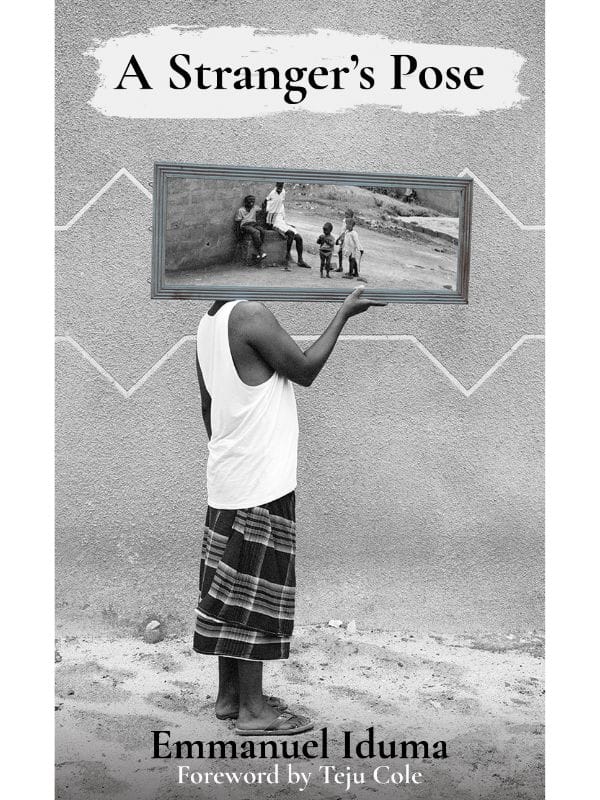
A Stranger’s Pose
₦9,000.00 – ₦12,000.00Price range: ₦9,000.00 through ₦12,000.00
What if the strangers you meet while travelling reveal more about home than the place you left behind?
A Stranger’s Pose by Emmanuel Iduma takes readers across African cities through intimate encounters, lyrical reflections and arresting photography.
From meeting legendary photographer Malick Sidibé in Bamako to listening to a migrant in Tangier contemplating the sea, each journey becomes a meditation on movement, loneliness, grief and human connection.
Beautiful, unconventional and deeply personal, this is African travel writing for anyone who believes a journey is measured by the people who briefly share it with us.
A Stranger’s Pose by Emmanuel Iduma
What if the strangers you meet while travelling reveal more about home than the place you left behind?
Emmanuel Iduma travels through cities across Africa carrying memories, questions and a photographer’s attentive eye.
He meets artists, migrants, friends and people whose lives briefly intersect with his own.
Some encounters last for hours. Others are preserved only through a photograph, gesture or unfinished conversation.
A Stranger’s Pose combines travel writing, memoir, poetry and photography to create an intimate portrait of movement across Africa.
It is not a conventional travel guide.
Instead, it asks what happens when a traveller stops trying to explain a place and begins listening to the people who inhabit it.
Travelling Across Africa in A Stranger’s Pose
The journey moves between cities including Dakar, Douala, Bamako, Benin, Khartoum, Addis Ababa, Casablanca, Tangier and N’Djamena.
The route is not presented as a simple progression from one destination to another.
Memories interrupt the present.
One city recalls an encounter that occurred somewhere else.
A photograph opens a path towards grief, intimacy or an absent loved one.
This fragmented structure allows readers to experience travel as Iduma experiences it.
Every destination is shaped by what came before and by the uncertainty of what will happen next.
A Stranger’s Pose becomes an emotional map rather than a conventional geographical record.
The Generosity of Strangers
At the centre of the book are the strangers who offer directions, stories, food, conversation and companionship.
Iduma approaches these encounters with curiosity rather than authority.
He does not claim to understand an entire city after spending a short time within it.
He concentrates on individual moments.
A stranger’s expression, posture or choice of words can reveal something no guidebook could explain.
These encounters show how quickly intimacy can develop between people who may never meet again.
They also reveal the uncertainty involved in approaching another person with a notebook or camera.
Trust must be requested rather than assumed.
Photography in A Stranger’s Pose
Photography is not included merely to illustrate the written journey.
The images carry their own histories, silences and emotional meanings.
Some photographs were made by Emmanuel Iduma.
Others come from acclaimed photographers whose work expands the book’s visual conversation.
The reader is invited to examine faces, clothing, architecture, landscapes and gestures.
Each image creates questions that the accompanying words do not always answer.
This relationship between text and photography makes A Stranger’s Pose especially valuable for readers interested in visual storytelling.
The photographs slow the journey and ask readers to look carefully before moving forward.
Meeting Malick Sidibé in Bamako
One of the book’s most memorable encounters takes place in Bamako.
Iduma meets Malick Sidibé, the internationally celebrated Malian photographer.
Sidibé became famous for photographs of youth culture, music, dancing and social life in post independence Mali.
The meeting brings the traveller into contact with a major figure in African photography.
It also creates an intimate exchange between two people connected by their interest in images.
Rather than turning Sidibé into a distant monument, Iduma observes the man, his surroundings and the details of their meeting.
The scene demonstrates how artistic influence can be experienced through presence as well as study.
Language, Translation and Communication
Travelling across different countries means moving between languages.
Iduma cannot always communicate with the people he encounters through words alone.
Sometimes understanding depends on gestures, expressions or the presence of a camera.
Translation becomes both necessary and incomplete.
A message may cross a linguistic border while losing some of its original meaning.
At other times, strangers understand one another without sharing a fluent language.
A Stranger’s Pose explores the vulnerability of needing another person to interpret a place, sentence or situation.
It shows that communication is often built from patience rather than perfect vocabulary.
Migration, Borders and the Search for Safety
Not everyone in the book travels with the same freedom.
Some people move for artistic discovery, work or personal curiosity.
Others travel because remaining home has become impossible.
In Tangier, Iduma speaks with a migrant who sees the sea as the only available route towards another life.
The Mediterranean represents hope, danger and uncertainty at the same time.
The encounter forces the reader to consider the unequal conditions under which people cross borders.
A passport can protect one traveller while its absence places another person in immediate danger.
The book approaches migration through individual encounters rather than reducing people to statistics.
Home, Loneliness and Intimacy
Travel does not free the narrator from memories of home.
The farther he moves, the more strongly absence follows him.
Family loss and separation from a lover shape the emotional atmosphere of the journey.
Hotels, borrowed rooms and temporary friendships remind him that he is rarely settled.
Yet loneliness also creates the possibility of unexpected intimacy.
Strangers become temporary companions.
A photograph can preserve the presence of someone who is no longer physically near.
A Stranger’s Pose asks whether home is a location, a person or a collection of remembered encounters.
Grief and the Lives Preserved in Photographs
Death appears quietly throughout the book.
Photographs preserve people at moments when they were alive, present and unaware of what would come later.
Looking at an image after someone has died changes how that photograph is understood.
It becomes evidence of a life and a reminder of absence.
Iduma writes about loss with restraint and tenderness.
He avoids turning grief into spectacle.
Instead, he considers how memory survives through images, letters and the stories people continue telling.
A New Kind of African Travel Writing
A Stranger’s Pose refuses familiar travel writing conventions.
It does not divide Africa into destinations to be rated, consumed or explained.
There are no lists of attractions or instructions about what a visitor should experience.
The book focuses on observation, uncertainty and human connection.
Africa is not treated as one undifferentiated place.
Each city contains its own histories, languages and rhythms.
The result is a complex and intimate portrayal of a continent viewed through many individual lives.
Poetry, Memoir and the Freedom of Form
The book moves freely between poetic fragments, remembered conversations, personal reflection and visual art.
Some sections feel like brief stories.
Others resemble diary entries, prose poems or letters that were never sent.
This formal variety reflects the unpredictable nature of travel.
Journeys rarely arrange themselves into perfect narratives.
They are remembered through flashes, faces and particular moments.
The book’s unconventional structure gives readers space to form their own connections between its fragments.
Recognition for A Stranger’s Pose
A Stranger’s Pose was longlisted for the 2019 RSL Ondaatje Prize.
The prize recognises distinguished writing that evokes the spirit of a place.
The book has also received international praise for expanding the possibilities of African travel writing.
Read more about its approach to travel, photography and human connection in The Atlantic’s examination of A Stranger’s Pose.
Why Read A Stranger’s Pose?
- A lyrical journey through numerous African cities
- Photography integrated with poetry and prose
- Intimate encounters with artists, migrants and strangers
- A memorable meeting with photographer Malick Sidibé
- Thoughtful reflections on home, grief and belonging
- An unconventional approach to African travel writing
- Insights into language, translation and communication
- A meditation on migration and unequal borders
- A foreword by acclaimed writer and photographer Teju Cole
- A book longlisted for the RSL Ondaatje Prize
Who Will Enjoy This Book?
A Stranger’s Pose will appeal to readers of travel writing, memoir, poetry and creative nonfiction.
Photographers and students of visual culture will appreciate the conversation between text and image.
It is also ideal for readers interested in African cities, migration and contemporary African art.
Readers who prefer reflective journeys to conventional travel guides will find the book especially rewarding.
Its compact sections make it suitable for slow reading, book clubs and university courses.
Explore More Books About Cities and Movement
Readers interested in photography and urban observation may also enjoy Every Day Is for the Thief by Teju Cole.
For another collaborative work crossing languages and national borders, explore Lumbung Stories.
Discover more journeys through African cities in Lagos: City of the Imagination by Kaye Whiteman.
About Emmanuel Iduma
Emmanuel Iduma is a Nigerian writer, editor, photographer and art critic.
His work explores art, travel, memory, loss and the relationship between images and language.
He has written widely about contemporary African art and photography.
He was also a cofounder of Saraba Magazine and cocurator of the Nigerian Pavilion at the 2017 Venice Biennale.
Order A Stranger’s Pose Today
A Stranger’s Pose is a beautiful meditation on travel and the people who briefly become part of our lives.
It invites readers to move slowly, observe carefully and resist easy conclusions about unfamiliar places.
Every photograph and encounter asks what it means to belong in a world shaped by movement.
Order A Stranger’s Pose today and experience Africa through an unforgettable collection of journeys, images and human connections.
| ISBN-10 | 9781911115496 |
|---|---|
| Book Author | |
| Book Type | Paperback |
| year_publication | 2018 |
| Pages | 216 |
Reviews
There are no reviews yet.