
ON FRIENDSHIP AS RESISTANCE
Jun
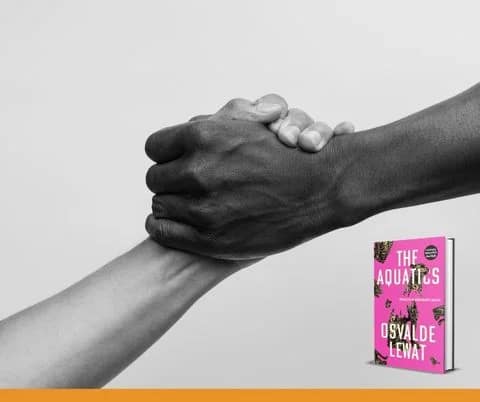
At the heart of The Aquatics is a friendship that refuses to remain private. As political oppression closes in, the bond between Katmé and Samy becomes more than a source of comfort, it becomes a test of loyalty, courage, and moral conviction. In this reflection, author, Osvalde Lewat explores friendship not simply as an emotional connection, but as a form of resistance against fear, conformity, and the forces that seek to isolate us from one another.
Friendship is often portrayed as a comfort zone and a space of emotional reciprocity. In my novel, however, it is first and foremost an ordeal — a moral, political, and existential one. I wanted to explore that moment when one’s bond with another person ceases to be comfortable because it becomes costly, that is, the moment when remaining loyal to someone threatens our social position, our privileges, our security, and sometimes even the image we have constructed of ourselves.
Friendship is not a bond protected by law, ritual, or biology. It exists only as long as one is willing to remain loyal to it. In The Aquatics, friendship becomes an absolute moral demand precisely because it offers no social cover. Katmé can justify her marriage, her motherhood, but she cannot justify abandoning Samy without betraying herself. Ideologies can be abstracted, postponed, rationalized. Friendship is immediate. It places a face in front of you and asks: What will you do now? Samy’s arrest forces Katmé to confront the gap between what she believes is right and what she is willing to risk. That gap is where the novel truly unfolds.
At the beginning of the novel, Katmé is a woman who has learned to survive through compromises. Raised in an environment where social scrutiny, patriarchal norms, and political order deeply shape individual lives, she learned early on to limit her desires in order to protect herself from disenchantment. Married to a powerful man, she gradually renounced herself — her profession, her aspirations, and an essential part of her inner freedom as a woman. As Samy puts it, she has accepted to live “as a lesser version of herself.” Katmé exists in a state of disenchanted lucidity in which social comfort has gradually replaced inner desire.
Samy is a deeply sensitive and vulnerable sculptor. He would use his work as a catalyst to make visible the social and political realities that those in power would kill to keep it folded. His arrest acts upon Katmé as a kairos, that is, a decisive turning point after which it becomes impossible to continue living as before. Until then, she had managed to maintain a precarious coexistence between her inner conscience and the structures of domination in which she was passively complicit. But when someone you love becomes the target of political power oppression, neutrality as an abstract position becomes an a non-affordable luxury that position you in the rank of an accomplice.
It is at this point that I see friendship as a position of resistance against the oppression.
Because, Katmé and Samy have been bound since adolescence by an all-encompassing friendship, let say fraternal in nature. Through the upheavals of their respective lives, they have always been for one another a place of refuge, an anchor, even a place to necessarily return to. But this friendship beyond being solely emotional embodies also a form of ethics. Here, being a friend means accepting to be transformed by the existence of your alter ego.
Standing by Samy means, for Katmé, risking her social status, her privileges, her comfort, the stability of her marriage, and the entire world of protection in which she had settled. Everything encourages her to distance herself to her friend to protect her respectability. In societies shaped by fear and arbitrariness, abandonment would often become the implicit condition of social survival for some people.
The true cost of loyalty is not only external. Remaining beside someone when everything pushes you toward abandonment can destroy the social self you once were. This can put you in the margins of a world, an order, an identity in which you had learned to hide yourself. Yet that loss can also become a way of saving oneself inwardly. For Katmé, supporting Samy means risking the life she has built for herself, but refusing to do so would mean surrendering completely to her own fear and inner capitulation.
Katmé’s journey reflects the idea that acts of resistance are often born from human attachment more from ideological conviction. The friendship between Katmé and Samy thus becomes a space irreducible to political control, a way of refusing to let another person disappear alone.
Through Samy, Katmé is forced to face the distance between the life she is living and the one she might have invented for herself. In this sense, friendship functions in the novel as a force of revelation. True friends are sometimes those who make our own inner escape impossible.
I believe that authoritarian regimes, as well as social systems founded on domination, seek to isolate individuals: dissidents, artists, minorities, vulnerable beings, you name them. Isolation produces fear, fear in it turn invents consent. Friendship, by contrast, creates a form of intimate solidarity that resists such fragmentation. It reminds us that there is still a place where a human being cannot be reduced to their social function, their fear, or their usefulness.
In the novel, loving a friend all the way through therefore is a radical political act in its very simplicity, that is, the act of refusing to abandon your friend means if you don’t do so, you are betraying yourself.
Shop The Aquatics
