
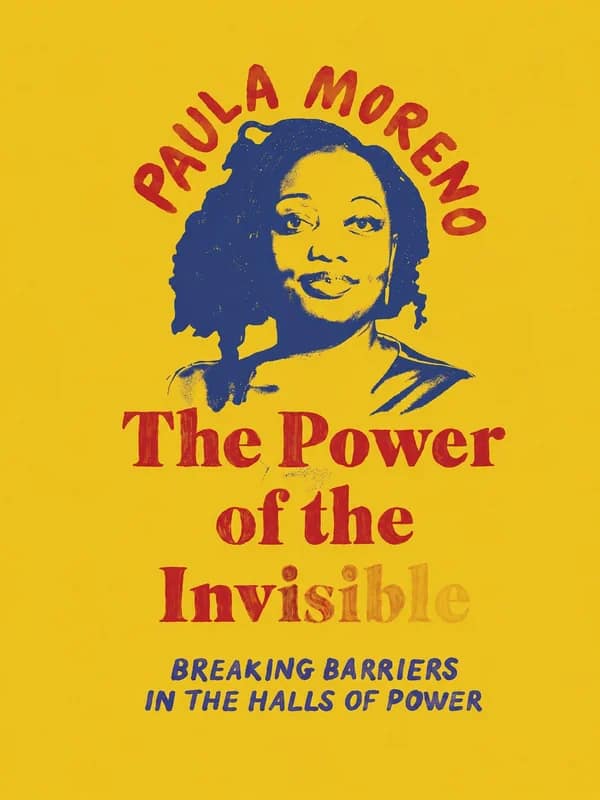
The Power of Invisible
₦15,000.00
What happens when a woman society has trained itself not to see enters the halls of power and refuses to disappear?
At only 28, Paula Moreno became Colombia’s youngest Minister of Culture and the first Afro Colombian woman to hold a ministerial position in the country.
The Power of the Invisible is her inspiring memoir of breaking racial and gender barriers, carrying the burden of representation and learning what it truly costs to lead.
Moving from her upbringing in Colombia to national office and global Black solidarity, Moreno offers an intimate account of courage, visibility, political power and the unfinished struggle for equality.
Essential reading for anyone inspired by Black women leaders who enter spaces that were never designed to include them and transform what is possible.
The Power of the Invisible: A Powerful Story of Leadership
What happens when a woman society has trained itself not to see enters the halls of power and refuses to disappear?
At only 28, Paula Moreno became Colombia’s youngest Minister of Culture and the first Afro Colombian woman to hold a ministerial position in the country.
Her appointment made history and created new possibilities for Black women and girls across Colombia.
However, entering government also exposed the racial, gender and political fault lines running through the country’s most powerful institutions.
The Power of the Invisible is Moreno’s intimate account of breaking barriers, carrying the burden of representation and discovering what leadership demands from people long excluded from power.
Blending memoir, political testimony and cultural reflection, she reveals how visibility can become both a historic breakthrough and a deeply personal burden.
From Invisibility to the Halls of Power
Paula Moreno’s rise to national office was not the result of an easy or predictable journey.
She grew up in a society where racial and economic inequalities shaped the opportunities available to Afro Colombian communities.
Her identity placed her outside the image of the person many expected to see in the country’s highest political offices.
Yet Moreno refused to accept that invisibility was the limit of what she could become.
Through education, discipline and an enduring commitment to public service, she entered spaces from which people like her had historically been excluded.
The Power of the Invisible follows that journey from her upbringing in Colombia to the centre of national political life.
It reveals the experiences, relationships and values that prepared her to lead when the opportunity finally arrived.
Colombia’s First Afro Colombian Woman Minister
In 2007, Moreno became Colombia’s first Afro Colombian woman cabinet minister.
She was also the youngest person to hold a cabinet position in the country when she was appointed Minister of Culture.
Her appointment was a powerful symbol of political progress.
For millions of Afro Colombians, seeing a Black woman occupy a national office challenged assumptions about who could represent the country and exercise authority.
However, symbolic breakthroughs do not automatically dismantle the systems that made them unusual.
Moreno entered institutions still shaped by discrimination, unequal access and established political expectations.
The Power of the Invisible examines what it means to become a symbol while still being expected to perform the demanding daily work of leadership.
The Cost of Being Seen
Visibility can create recognition, opportunity and influence.
It can also expose a person to intense scrutiny, unrealistic expectations and hostility.
As a young Black woman in government, Moreno carried more than the ordinary responsibilities of political office.
She was frequently treated as a representative of an entire race, gender and generation.
Success could open doors for others, but failure risked being used to justify the prejudices that had kept those doors closed.
This burden is familiar to many people who become the first from their communities to enter powerful institutions.
The Power of the Invisible explores how Moreno navigated that pressure without losing her connection to the communities her presence represented.
Leadership Beyond Political Office
Moreno’s understanding of leadership extends beyond holding an impressive title.
True power is also found in communities, social movements and the people performing essential work without public recognition.
After leaving government, she founded Corporación Manos Visibles, also known as the Visible Hands Foundation.
The organisation works to strengthen leadership and promote racial equality in Colombia and across Afro descendant communities.
Its name reflects a central argument of the memoir.
Many of the people holding societies together remain invisible because their labour, knowledge and leadership are not recognised by traditional institutions.
The Power of the Invisible asks what could change if those leaders received the resources, attention and authority they deserve.
Race, Gender and Political Power
This memoir offers an insider’s examination of race and representation within political institutions.
Moreno describes what it means to exercise authority in spaces that have historically concentrated power among social and political elites.
Her position did not protect her from racism or sexism.
Instead, political visibility sometimes made those structures clearer.
The book explores how race and gender can influence whose expertise is respected, whose leadership is questioned and whose mistakes are magnified.
It also considers the limits of representation when institutions remain resistant to deeper change.
The Power of the Invisible makes clear that having one Black woman in office matters, but lasting equality requires transforming the systems surrounding her.
The Strength of Afro Diasporic Solidarity
Moreno’s story is rooted in Colombia, but it is also connected to wider networks of Black and Afro diasporic solidarity.
Across the Americas and other regions, Afro descendant communities share histories shaped by displacement, resistance, cultural survival and the struggle for recognition.
These connections helped shape Moreno’s understanding of leadership and responsibility.
They revealed that barriers facing Afro Colombians were part of broader patterns of racial exclusion.
They also offered examples of community building, resilience and political imagination.
Through these international relationships, The Power of the Invisible places Moreno’s personal journey within a global conversation about Black leadership and collective liberation.
A Memoir About Courage and Responsibility
This is not a memoir that presents success as an individual triumph disconnected from community.
Moreno recognises the family members, mentors, colleagues and movements that helped make her achievements possible.
Her journey demonstrates that no leader becomes powerful alone.
Every breakthrough rests on visible and invisible forms of support.
The book also considers the responsibility that accompanies becoming the first.
Opening a door matters, but ensuring that others can pass through it matters even more.
The Power of the Invisible therefore becomes a story about transforming personal opportunity into wider social change.
Why You Should Read The Power of the Invisible
- It tells the true story of Colombia’s first Afro Colombian woman minister.
- It follows Paula Moreno’s rise to office at only 28.
- It explores race, gender and representation within government.
- It reveals the personal cost of becoming a historic first.
- It examines how visibility can be both opportunity and burden.
- It connects political leadership with community responsibility.
- It celebrates Afro Colombian and Afro diasporic solidarity.
- It challenges narrow ideas about who can exercise power.
- It combines memoir, political testimony and cultural reflection.
- It offers inspiration without ignoring the structures that make progress difficult.
Who Should Read This Memoir?
The Power of the Invisible is ideal for readers interested in Black women’s memoirs, political leadership and Afro Colombian history.
It will also appeal to readers seeking books about racial equality, women in government and leadership through adversity.
Young professionals and emerging leaders will find valuable reflections on responsibility, visibility and navigating institutions that may not expect them to succeed.
The book is equally relevant to university courses and book clubs exploring leadership, gender studies, Latin American politics and the African diaspora.
Readers interested in civil rights, social justice and institutional change will find Moreno’s account both revealing and urgent.
Explore more compelling titles in Cassava Republic Press’s African and Black nonfiction collection.
You can also discover more stories of extraordinary women in the African and Black women’s stories collection.
About Paula Moreno
Paula Moreno is an engineer, political leader and advocate for racial equality.
In 2007, she became the first Afro Colombian woman and the youngest person to hold a cabinet position in Colombia when she was appointed Minister of Culture.
She is the founder and president of Corporación Manos Visibles, one of Latin America’s leading organisations advancing racial equality and community leadership.
Moreno has also served on the Ford Foundation Board of Trustees and worked across international networks representing Afro descendant communities.
Her leadership demonstrates the transformative possibilities created when people pushed to society’s margins gain the resources and authority to shape its future.
Learn more about her work through Paula Moreno’s official website.
Preorder The Power of the Invisible Today
The Power of the Invisible is a clear and inspiring account of what it means to enter power as someone long excluded from it.
Paula Moreno’s journey proves that representation can change what a society believes is possible.
Her story also reminds readers that the work of equality does not end when one person breaks through a barrier.
Preorder your copy today and discover how an invisible girl became a historic leader who opened doors for generations to follow.
| Weight | 0.5 kg |
|---|---|
| ISBN | 978-1-913175-98-6 |
| Author | Paula Moreno |
| Format | Hardback |
| Publication Date | 26th May 2026 |
Reviews
There are no reviews yet.