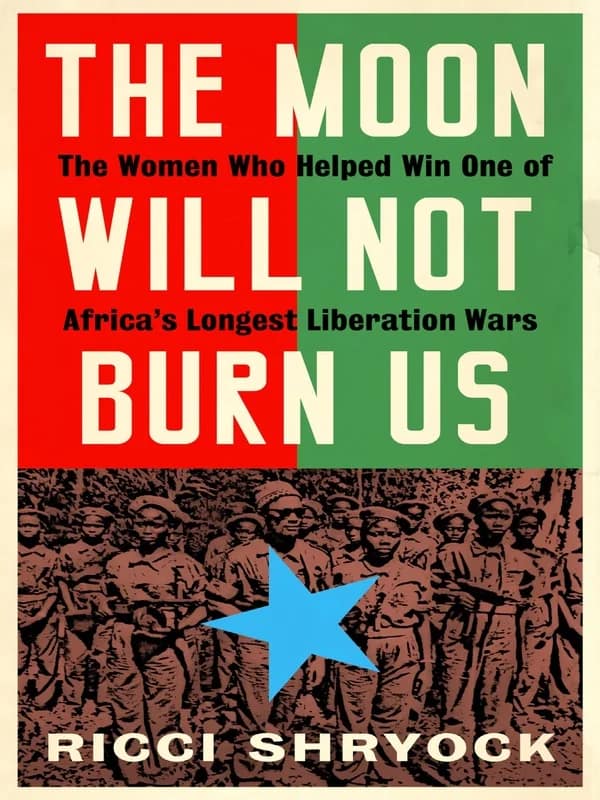
The Moon Will Not Burn Us
£16.99
History remembers the men who won wars. This book names the women it forgot.
At only 13, Joana Gomes is pulled into Guinea Bissau’s brutal struggle for independence after her father is murdered.
Alongside a courageous group of female combatants, she risks everything to help defeat Portuguese colonial rule and transform the future of her nation.
The Moon Will Not Burn Us by Ricci Shryock is the extraordinary true story of the women who fought for freedom, changed history and were later pushed to its margins.
Powerful, intimate and deeply human, this is essential reading for anyone interested in African history, women’s resistance and the personal cost of liberation.
Available on backorder
The Moon Will Not Burn Us: A Powerful Story of Freedom
History remembers the men who won wars. This book names the women it forgot.
At only 13 years old, Joana Gomes is thrust into Guinea Bissau’s brutal struggle for independence after the murder of her father.
Her search for justice leads her towards a determined group of female combatants fighting to end Portuguese colonial rule.
These women carry messages, gather intelligence, organise communities and take enormous personal risks.
Their contributions become essential to a liberation movement that will transform Guinea Bissau, Cape Verde and Portugal itself.
Yet when the fighting ends, many of the women who made victory possible are excluded from power and pushed out of the history they helped create.
The Moon Will Not Burn Us by Ricci Shryock recovers their stories and places women at the centre of one of Africa’s most important liberation struggles.
The Extraordinary True Story of Joana Gomes
Joana Gomes is still a child when political violence enters her life and changes its direction.
Following her father’s murder, grief and a desire for justice pull her into a conflict far greater than herself.
She joins other women and girls whose courage, labour and strategic contributions become vital to the independence movement.
Joana’s journey offers an intimate entrance into the wider history of Guinea Bissau and Cape Verde’s 11 year war against Portuguese colonial rule.
Her experience is not presented as a simple or romantic story of heroism.
It reveals the fear, loss, love, heartbreak and difficult choices concealed behind the public language of revolution.
The Moon Will Not Burn Us shows what happens when a young woman sacrifices herself for national freedom and must later live with the personal consequences.
The Women Who Liberated Guinea Bissau
Women were essential to the liberation movement, but their contributions took many different forms.
Some took up arms. Others carried information, transported supplies, treated the wounded or organised communities.
They also performed the daily labour that allowed the resistance to survive.
These responsibilities demanded intelligence, secrecy, endurance and extraordinary courage.
The women faced the same dangers as their male comrades.
They also confronted expectations about gender, family and the roles society believed women should perform.
After independence, men claimed much of the political authority and historical recognition.
The contributions of women were frequently reduced, romanticised or forgotten.
The Moon Will Not Burn Us challenges this erasure by recognising women as strategists, organisers, fighters and political participants in their own right.
An 11 Year War That Changed History
The war for the independence of Guinea Bissau and Cape Verde lasted for 11 gruelling years.
It brought local resistance into a wider international struggle involving colonialism, African independence and competition between global powers.
The conflict helped bring Portuguese colonial rule in Africa to an end.
Its repercussions also reached Portugal, where political change ended dictatorship and accelerated decolonisation.
These international consequences provide the historical background of the book.
However, Ricci Shryock keeps the experiences of Joana and her fellow female combatants at its emotional centre.
This balance gives The Moon Will Not Burn Us both historical importance and personal urgency.
Readers encounter governments and political movements, but they also meet the people whose bodies, families and relationships carried the true cost of war.
Women’s Work Behind a Revolution
This book questions how societies recognise women’s contributions to political change.
The woman carrying a weapon may be remembered because she fits a dramatic image of revolution.
However, liberation movements also depend on less visible forms of work.
Cooking, caring, communicating, organising and protecting communities may not appear heroic in official accounts.
Yet this work can determine whether a resistance movement survives.
The Moon Will Not Burn Us asks readers to reconsider what counts as political labour and whose contribution deserves to be preserved.
It also exposes the contradiction between fighting for national freedom and failing to extend equality to the women who helped achieve it.
Love, Loss and the Cost of Liberation
National histories often describe victory through dates, leaders and political declarations.
They rarely reveal what freedom demanded from the individuals who fought for it.
Joana and her fellow combatants must live with separation, danger and the possibility of death.
They also face the emotional consequences of choices made under extreme circumstances.
The struggle shapes their friendships, families, relationships and understanding of themselves.
When independence finally arrives, freedom does not automatically repair everything the war has broken.
The Moon Will Not Burn Us explores the painful distance between the promise of liberation and the complicated reality that follows it.
Why This Forgotten History Matters
Historical records influence whose courage is celebrated and whose suffering is recognised.
When women are removed from those records, future generations receive an incomplete account of how political change happened.
Restoring these stories is not simply about adding women to an existing narrative.
It requires reconsidering how history defines leadership, resistance, sacrifice and power.
By centering Joana Gomes and other female combatants, The Moon Will Not Burn Us expands our understanding of African liberation history.
It also raises urgent questions about the many women whose contributions remain hidden in political movements around the world.
Why You Should Read The Moon Will Not Burn Us
- It tells the extraordinary true story of Joana Gomes.
- It centres the women who helped liberate Guinea Bissau.
- It reveals women’s military, political and community contributions.
- It explores Guinea Bissau and Cape Verde’s independence struggle.
- It examines Portuguese colonialism and African resistance.
- It connects political history with love, grief and sacrifice.
- It challenges the exclusion of women from official history.
- It offers a deeply human approach to African nonfiction.
- It reconsiders how women’s labour is recognised and valued.
- It preserves an important history for future generations.
Who Should Read This Book?
The Moon Will Not Burn Us will appeal to readers of African history, women’s history, political biography and narrative nonfiction.
It is essential reading for anyone interested in decolonisation, African independence movements and Portuguese colonialism.
It will also engage readers interested in women’s political participation and forgotten female revolutionaries.
Readers seeking true stories about courageous women and the personal realities behind major historical events will find Joana’s journey compelling.
The book is equally valuable for libraries, book clubs and university courses.
It is especially relevant to African studies, gender studies, colonial history, political movements and human rights.
Discover more important works in Cassava Republic Press’s African and Black nonfiction collection.
You can also explore books centring women’s lives in the African and Black women’s stories collection.
About Ricci Shryock
Ricci Shryock is a writer and photographer based in Dakar, Senegal.
She moved to Dakar in 2008 and has spent years reporting on West African lives, communities and political realities.
Her journalism and photography have appeared in publications including The New Yorker and The New York Times.
Shryock’s work seeks to place West African realities at the centre of their own stories.
In The Moon Will Not Burn Us, she draws on extensive reporting to recover a little known history of women, revolution and national liberation.
Learn more about her documentary and journalistic work on Ricci Shryock’s official website.
Preorder The Moon Will Not Burn Us Today
The Moon Will Not Burn Us is a powerful record of women who refused to surrender their country’s future.
It restores Joana Gomes and her fellow combatants to their rightful place within the story of Guinea Bissau’s liberation.
It also honours the visible and invisible work through which women have sustained resistance movements across generations.
Preorder your copy today and discover the extraordinary true story of the women who fought for freedom, changed nations and transformed history.
| Weight | 0.5 kg |
|---|---|
| ISBN | 978-1-913175-86-3 |
| Author | Ricci Shryock |
| Format | Hardback |
| Publication Date | 19th August 2026 |
Reviews
There are no reviews yet.