
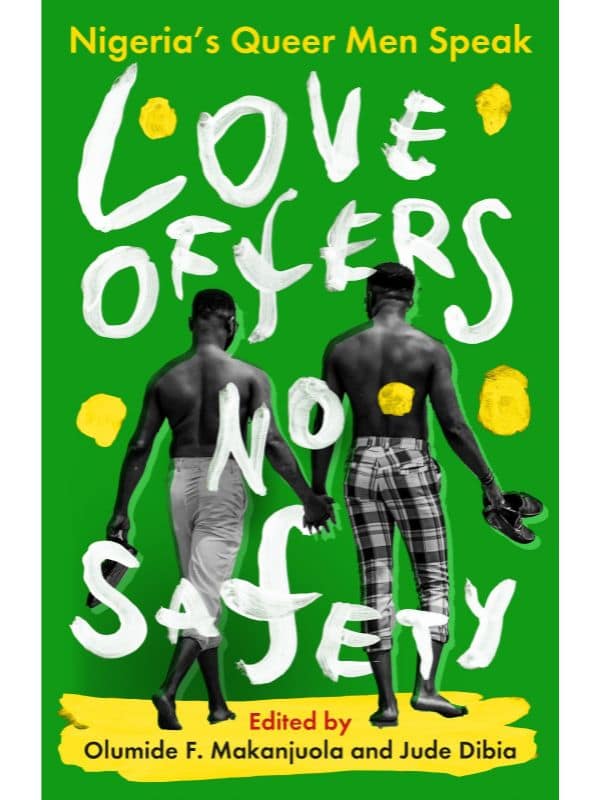
Love Offers No Safety
£16.99
What does it cost to love openly when safety is never guaranteed?
In Love Offers No Safety: Nigeria’s Queer Men Speak, 25 men break through silence to tell their own stories of love, heartbreak, faith, family, masculinity and survival. Honest, intimate and deeply human, these narratives reveal that there is no single way to be queer or to be a man in Nigeria.
Edited by Olumide F. Makanjuola and Jude Dibia, this powerful collection replaces stereotypes with real voices and invites every reader to listen.
Love Offers No Safety: Twenty Five Powerful Queer Nigerian Voices
What does it mean to search for love when being known can place your safety at risk?
How do you build relationships, friendships and a sense of belonging when society has already decided that your identity should remain hidden?
In Love Offers No Safety: Nigeria’s Queer Men Speak, 25 men from different parts of Nigeria tell their stories in their own words. They speak about love, heartbreak, family, faith, masculinity, prejudice and the determination to build meaningful lives despite social and legal hostility.
Edited by Olumide F. Makanjuola and Jude Dibia, this intimate work of LGBTQ Nigerian nonfiction refuses to present queer men as statistics, political arguments or abstract identities. It allows them to speak as complete human beings whose lives contain tenderness, confusion, pleasure, disappointment, resistance and hope.
Twenty Five Stories and No Single Queer Experience
The narrators come from different generations, social classes, religious backgrounds and parts of Nigeria. Their experiences demonstrate that there is no universal way to be queer.
Some recognised their attraction to other men at an early age. Others spent years trying to suppress or reinterpret their feelings because they had never encountered language that could help them understand themselves.
Some found acceptance among friends or chosen family. Others experienced rejection from the people whose support mattered most.
Their stories include romance, intimacy and moments of joy, but they also reveal the pressures created by secrecy, discrimination and fear.
This variety is one of the collection’s greatest strengths. Love Offers No Safety does not attempt to force 25 lives into a single account of Nigerian queerness. Each narrator retains his own voice, contradictions and understanding of what it means to live and love.
Love in an Environment of Fear
Love can offer comfort, but it cannot always provide protection. For queer men living in a hostile environment, romantic relationships may be shaped by the constant possibility of exposure.
A private message, public gesture or trusted friend can become a source of danger. The need to remain hidden may affect who a person dates, where two people meet and whether they can imagine sharing a future.
The title Love Offers No Safety captures this painful reality. Love may provide emotional refuge, but it cannot automatically remove discriminatory laws, family rejection or social violence.
Even so, the men in this collection continue searching for connection. Their willingness to love, form communities and tell their stories becomes an expression of resistance.
Faith, Family and the Search for Belonging
Family and religion play important but complicated roles throughout these personal accounts.
For some narrators, faith offers comfort and a sense of community. For others, religious teaching becomes a source of shame, fear or rejection.
Family relationships are equally complex. Many men want to remain connected to their parents, siblings and extended families while knowing that honesty could change those relationships permanently.
These accounts explore the emotional labour required to manage different versions of oneself. A person may be open with friends but silent at home. He may participate in religious life while questioning the messages he hears about his identity.
The narrators demonstrate that coming out is not a single event with the same consequences for everyone. In some circumstances, privacy becomes a deliberate form of self protection rather than evidence of cowardice.
Questioning Masculinity in Nigeria
Love Offers No Safety is also an exploration of what society expects a man to be.
From childhood, boys are often taught to hide vulnerability, display strength and conform to narrow ideas about heterosexual masculinity. These expectations can make it difficult for men to understand their emotions or communicate honestly with one another.
The collection examines how toxic masculinity affects queer men, but it also shows how restrictive definitions of manhood limit everyone.
When masculinity is measured through domination, silence and emotional distance, men may struggle to build healthy relationships. Women and other members of society are also affected by the same structures.
By presenting many different forms of male identity, the book challenges readers to reconsider what being a man can mean. Courage may be found in tenderness. Strength may include vulnerability. Masculinity does not have to depend on controlling or rejecting others.
Replacing Stereotypes with Real Voices
Public conversations about LGBTQ people in Nigeria frequently occur without queer Nigerians being allowed to speak for themselves.
They are discussed through politics, religion, law and sensational media coverage. Their ordinary lives, aspirations and relationships can disappear behind hostile arguments.
This collection changes that perspective by placing queer Nigerian men’s stories at the centre. Readers encounter individuals rather than stereotypes.
The men speak about attraction, friendship, work, family, loneliness, community and the desire to be understood. Their experiences are specific, but the underlying need for dignity and belonging is universal.
This makes the book valuable to queer readers who want to recognise elements of their own lives. It is equally important for family members, teachers, students, policymakers and allies who want to understand experiences that are frequently hidden.
Why This Collection Matters
- It contains 25 first person narratives from queer Nigerian men.
- It represents different ages, classes, religions and regions.
- It explores love, heartbreak, faith, family and survival.
- It challenges stereotypes about queer Nigerians.
- It examines how social pressure produces toxic masculinity.
- It provides an important record of contemporary Nigerian life.
- It centres queer people as authorities on their own experiences.
- It creates opportunities for empathy, education and meaningful conversation.
Love Offers No Safety is suitable for adult readers of African queer books, social history, gender studies, memoir and contemporary Nigerian nonfiction.
It is also an excellent choice for university courses, book clubs and organisations exploring gender, sexuality, human rights, masculinity or African social movements.
Edited by Two Influential Nigerian Queer Voices
Olumide F. Makanjuola is a Nigerian sexual health and human rights advocate whose work expands public knowledge and discussion of queer experiences. His approach recognises storytelling as a powerful instrument for education and social change.
Jude Dibia is an award winning Nigerian novelist and queer rights advocate. His debut novel, Walking with Shadows, was among the first full length Nigerian novels centred on queer identity.
Together, the editors have created a collection that protects the individuality of each narrator while revealing the wider structures connecting their experiences.
Read and Explore More Queer African Stories
Read an extract from the collection through the Johannesburg Review of Books.
Discover more writing in Cassava Republic’s African and Black Queer Voices collection.
Readers can also purchase the Love Offers No Safety and She Called Me Woman bundle to encounter a broader range of queer Nigerian experiences.
Order Love Offers No Safety Today
Love Offers No Safety is a courageous record of men refusing to let prejudice have the final word on their lives.
Order your copy today and listen to 25 queer Nigerian men tell their own stories of love, fear, masculinity, identity and survival.
| ISBN-10 | 1913175481 |
|---|---|
| Book Author | |
| Book Type | |
| year_publication | 2023 |
| Pages | 144 |
Reviews
There are no reviews yet.